How it works
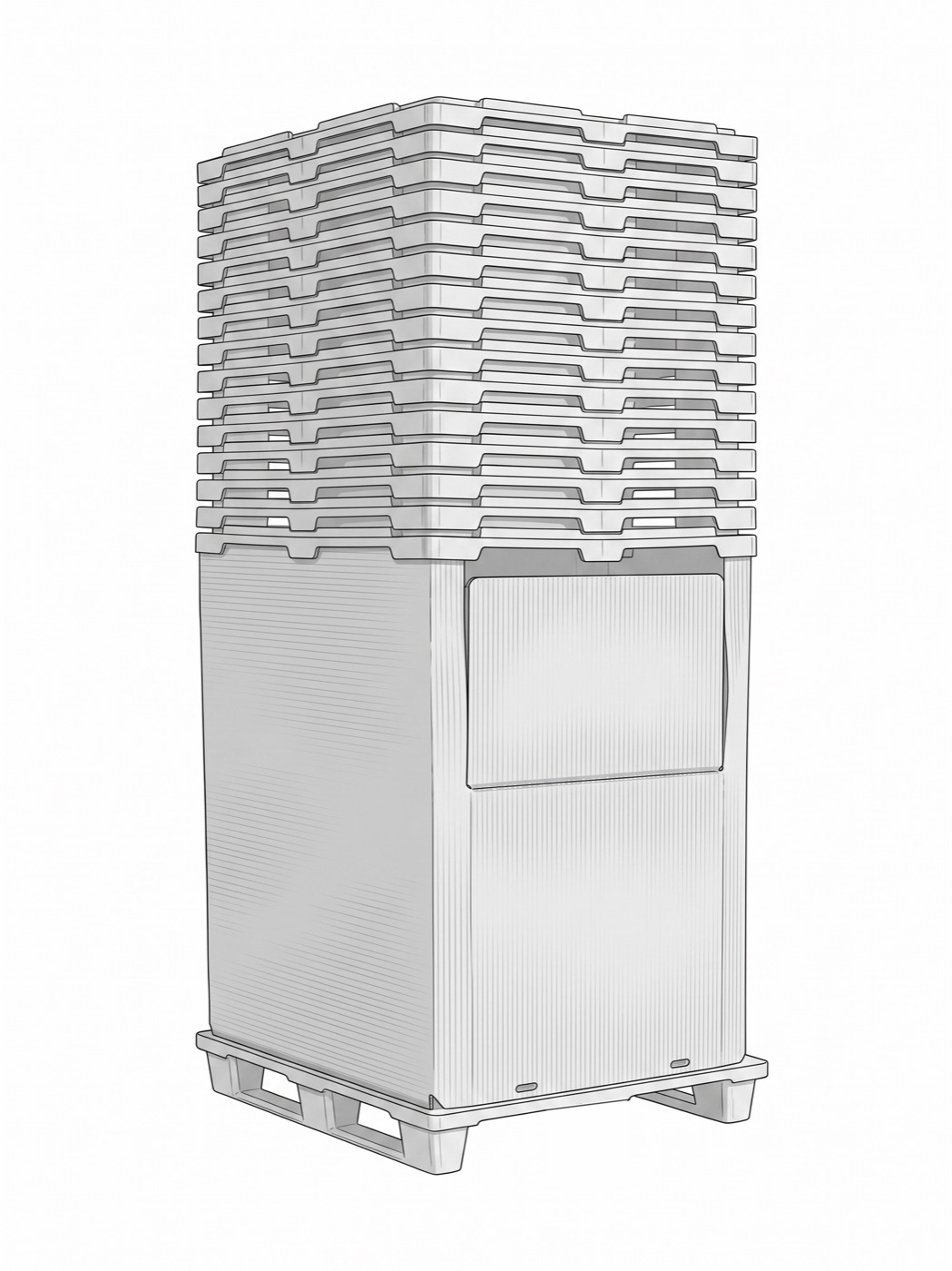
Stackable when loaded. Nestable when empty.
Until now you had to choose. A system that stacks under load takes up the same space when it is empty. A system that nests when empty cannot carry anything on top. NESTAX does both, and that single change is what the numbers below come from.
The invention
Normally a lid closes the box. Ours is the pallet.
The pallet of the unit above closes the unit below. That removes the third component entirely: no lid to produce, store, clean, track or lose. It is also what lets the pallet nest and the sleeve stay light.
Two parts, nothing else. A plastic pallet is not new and a sleeve is not new. One unit that stacks loaded and nests empty is, and that is what the patent covers.
Specification
One unit, two parts
- Footprint
- 1175 x 775 x 1295 mm, Euro pallet base
- Weight
- about 17 kg per complete unit
- Pallet
- recycled HDPE
- Sleeve
- recycled PP, 5 mm wall
- Recycled content
- 100 percent
- Fasteners
- none, handles and ribs are in the wall geometry
- Loaded
- rigid, stacks two high in normal logistics
- Empty
- sleeve folds, pallets nest, 17 units per module
- Patent
- P139312NL00
The proof, transport
Per truck on the way back
264
steel cages, folded flat
363
folding containers
561
NESTAX units
Same truck, same trip, thirty three pallet places. For every three return trips the existing systems need, we make one disappear.
The proof, CO2
Half gone against the container. 82% against steel.
| Per unit over 30 cycles, kg CO2-eq | Steel cage | Folding container | NESTAX |
|---|---|---|---|
| Material, 75 kg steel against 38 and 17 kg of plastics, including 15% replacement | 150.0 | 30.6 | 13.7 |
| Return leg, empties going home, 264 against 363 and 561 per truck | 35.8 | 26.0 | 16.8 |
| Outbound leg, the packaging’s share of the load | 41.5 | 20.2 | 9.4 |
| Total | 227.3 | 76.8 | 39.9 |
The larger gain is not the trip home. It is the weight you are not hauling on the way out.
Sources: plastics factors CE Delft 2022 for NRK Recycling, recycled content approach, no end of life credit applied. Steel at 2.0 kg CO2 per kg, worldsteel primary route. Foldable steel cage 1200 x 800, 75 kg, 8 high folded.
The proof, lifespan
Thirty cycles is the floor, not the ceiling
12 yr
our own plastic pallets in service, running 30 or more cycles a year. The pallet is not the concern.
11x
we can build the complete system eleven times over for the material footprint of one steel cage.
1.3 kg
CO2 per trip, everything in, against 4.1 for a cage that lives a hundred trips.
Our pallet will not outlive a steel cage, and it does not have to. Long life is not the same as low impact. A broken sleeve is ground up and becomes the next one at 6.3 kg of CO2, and after five trips the weight saved has already paid for it. Fifteen per cent replacement is priced in.
The proof, cost
Cheapest line on the page, bought or rented
Bought, over 30 cycles
Rented, over the same 30 trips
Against the pool we break even after four trips, against the steel cage after twelve. Freight, handling, storage and repair are included in every line. And in commodity food, every euro saved here ends up in the price on the shelf.
Where else this works
One system, many loops
The principle carries anywhere goods are light, high in volume, and moving in a loop that repeats.
Fresh and produce
Where we start, and where the space constraint is worst.
Horticulture
Young plants and trays, seasonal peaks, tight margins.
Parcel and fashion
Bulk parcels and garments between hubs, returns included.
Packaging itself
Empty trays and formed parts. Light, voluminous, and our own first proof.
Site to site loops
Between your own locations, where the law wants 100 percent reusable.